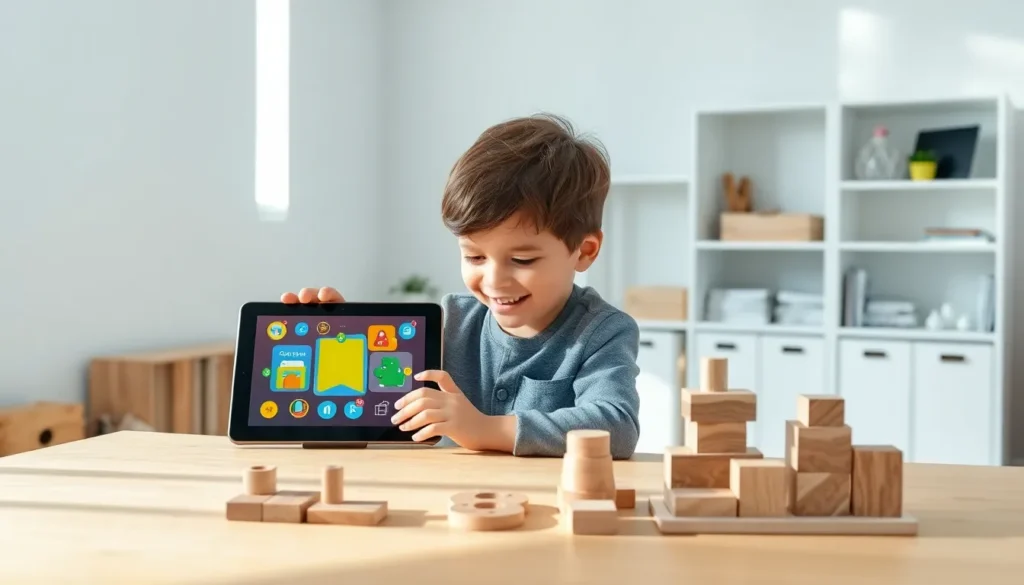
Educational apps and toys techniques have transformed how children learn. Parents now have access to tools that turn playtime into productive skill-building sessions. But here’s the challenge: with thousands of options available, knowing which methods actually work can feel overwhelming.
The good news? Research shows that combining digital learning with hands-on play creates powerful educational outcomes. This guide breaks down proven techniques for selecting the right educational apps and toys, blending screen time with physical activities, and setting boundaries that keep learning fun and effective.
Table of Contents
ToggleKey Takeaways
- Educational apps and toys techniques work best when they require active participation—tapping, solving puzzles, or manipulating objects—rather than passive watching.
- Combining digital learning with hands-on play creates stronger educational outcomes by connecting abstract concepts to concrete experiences.
- Quality educational apps adapt to your child’s skill level, provide meaningful feedback on mistakes, and reward effort over correct answers.
- Match learning toys to developmental stages: motor-skill toys for toddlers, pretend-play items for preschoolers, and STEM kits for elementary-age children.
- Screen time quality matters more than quantity—set consistent boundaries and prioritize interactive apps over passive content.
- Co-play with parents amplifies learning benefits by transforming screen time into interactive, question-rich experiences.
Understanding the Science Behind Educational Play
Children learn best through play. This isn’t just parental wishfulness, it’s backed by decades of cognitive research. When kids engage with educational apps and toys, their brains form neural connections that support memory, problem-solving, and creativity.
The key lies in active engagement. Passive activities like watching videos produce fewer learning benefits than interactive experiences. Educational apps and toys techniques that require children to make choices, solve puzzles, or manipulate objects activate multiple brain regions simultaneously.
Studies from developmental psychologists show that play-based learning improves:
- Working memory – Kids retain information better when they discover it through exploration
- Executive function – Interactive play strengthens attention control and cognitive flexibility
- Social-emotional skills – Many educational toys encourage cooperation and communication
The most effective educational apps and toys share common features. They provide immediate feedback, adjust difficulty based on performance, and reward effort rather than just correct answers. These elements keep children motivated while building genuine competencies.
Choosing the Right Educational Apps for Your Child
Not all educational apps deliver equal results. Some dress up basic entertainment with a “learning” label. Others provide genuine cognitive benefits. Parents need practical criteria to tell the difference.
First, look for apps that require active participation. The child should tap, swipe, speak, or solve problems, not just watch animations. Educational apps and toys techniques work best when they demand thinking, not passive consumption.
Second, check whether the app adapts to your child’s level. Quality educational apps adjust difficulty automatically. If a child struggles, the app provides hints or easier challenges. If they excel, it introduces harder content. This keeps kids in their “zone of proximal development”, challenged but not frustrated.
Third, examine the feedback mechanism. Good apps tell children why an answer was wrong, not just that it was wrong. This transforms mistakes into learning opportunities.
Some categories consistently produce strong results:
- Phonics and reading apps – Apps like Teach Your Monster to Read use games to build literacy skills
- Math apps – Programs that visualize number concepts help kids grasp abstract ideas
- Coding apps – Even preschoolers can learn sequencing and logic through simple coding games
Parents should also consider content alignment with school curriculum. Educational apps and toys techniques prove most effective when they reinforce what children learn in formal settings.
Selecting Age-Appropriate Learning Toys
Physical toys remain essential for child development. They offer sensory experiences that screens cannot replicate. The trick is matching toys to developmental stages.
For toddlers (ages 1-3), focus on toys that build motor skills and cause-effect understanding. Shape sorters, stacking blocks, and simple puzzles work well. These toys teach spatial reasoning and hand-eye coordination through repetition.
Preschoolers (ages 3-5) benefit from toys that encourage pretend play and basic academic concepts. Magnetic letters, counting toys, and building sets like LEGO Duplo support early literacy and numeracy. At this stage, educational apps and toys techniques should emphasize exploration over instruction.
Elementary-age children (ages 6-10) can handle more complex challenges. Science kits, strategy board games, and construction sets with detailed instructions build critical thinking. STEM toys that involve experiments or coding concepts prepare kids for future academic demands.
When selecting toys, consider these factors:
- Open-ended design – Toys with multiple uses encourage creativity
- Durability – Quality toys withstand repeated use and grow with the child
- Engagement potential – Will the child return to this toy after the novelty fades?
The best learning toys feel like play first and education second. Children shouldn’t feel like they’re doing assignments.
Effective Techniques for Combining Digital and Physical Learning
The most powerful educational apps and toys techniques blend digital and physical experiences. This combination leverages the strengths of both approaches.
One effective method is using apps to extend physical play. After a child builds something with blocks, they might photograph it and use an app to animate their creation. This connects tangible effort with digital outcomes.
Another approach involves apps that direct physical activities. Some educational programs give children real-world challenges, measure items around the house, conduct simple experiments, or create art projects. The screen provides guidance while the learning happens offline.
Parents can also create intentional sequences. A child might:
- Use an app to learn about animals
- Play with toy animals to reinforce concepts
- Visit a zoo or nature area to see real examples
- Return to the app for review activities
This multi-modal approach strengthens memory and understanding. Educational apps and toys techniques that connect abstract concepts to concrete experiences produce deeper learning.
Co-play amplifies these benefits. When parents engage alongside children, asking questions, making observations, expressing enthusiasm, the educational value multiplies. Adult involvement transforms passive screen time into interactive learning sessions.
Setting Healthy Boundaries and Screen Time Limits
Educational apps and toys techniques only work within healthy usage patterns. Even the best educational app loses value when overused.
The American Academy of Pediatrics recommends these guidelines:
- Under 2 years – Avoid screens except video chatting
- Ages 2-5 – Limit to one hour of high-quality programming daily
- Ages 6 and up – Set consistent limits that ensure adequate sleep, physical activity, and screen-free time
But blanket time limits miss an important point: what children do on screens matters more than raw minutes. Thirty minutes of an interactive math app provides more benefit than two hours of passive video watching.
Practical strategies for managing educational screen time include:
- Designate tech-free zones – Keep screens out of bedrooms and away from meal tables
- Create a media plan – Decide which apps are approved and when they can be used
- Model good habits – Children mimic adult behavior with devices
- Use timers – Visual countdown timers help kids transition off screens without conflict
Balance remains essential. Children need unstructured play, outdoor time, and face-to-face interaction. Educational apps and toys techniques work best as part of a varied developmental diet, not as the main course.
Parents should regularly evaluate whether screen activities produce positive outcomes. If a child becomes irritable after app use or resists transitioning to other activities, adjustments may be needed.